'There Was No Room in the Inn'… Or Was There No Inn at All?
Christmas is coming and the familiar nativity story will be retold once again, almost certainly including these details:
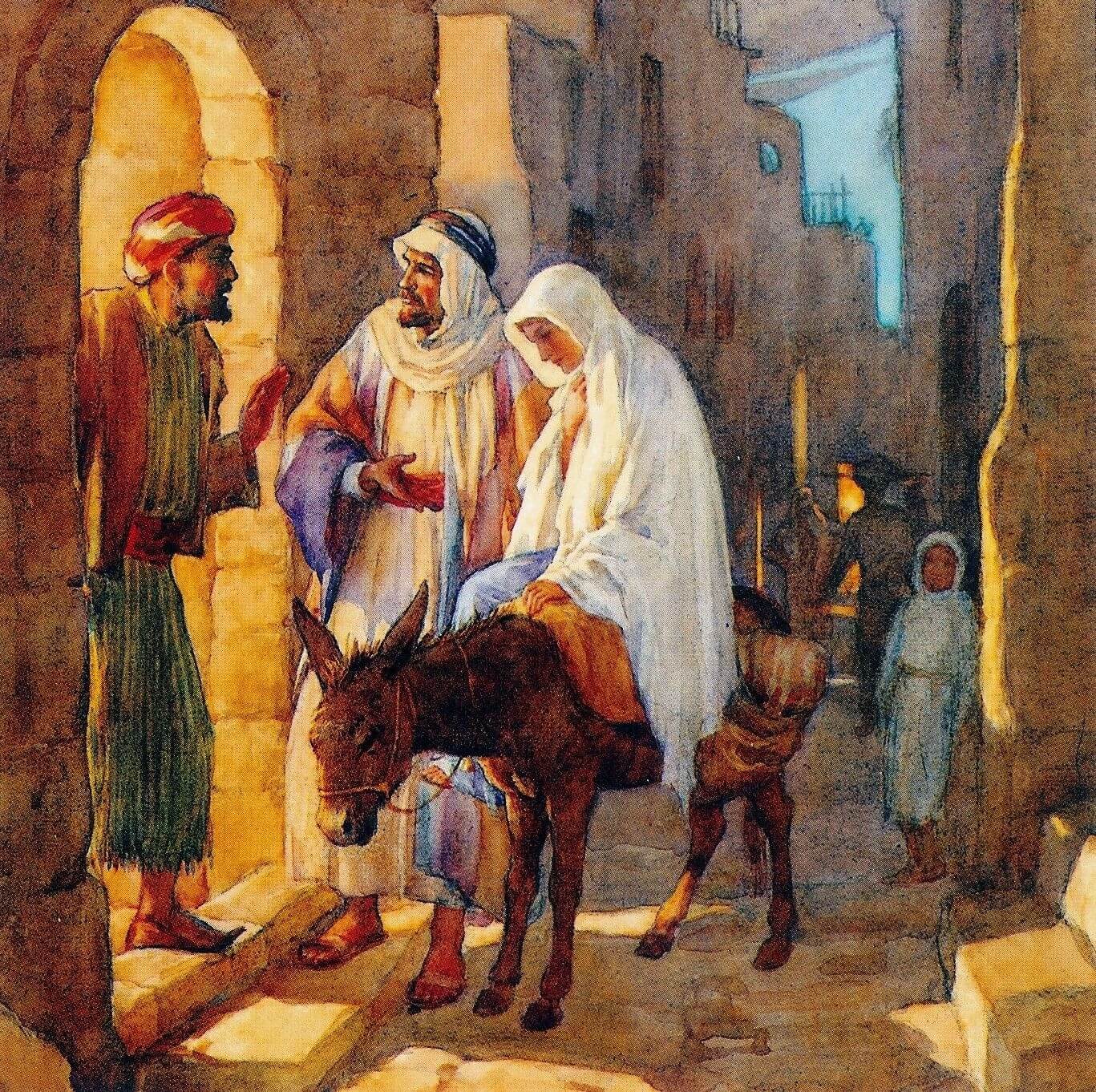
- Joseph with a pregnant Mary traveled to Bethlehem rushing to find lodging because the baby was due any moment.
- "There was no room for them in the inn", demonstrated by a sometimes empathetic, sometimes mean-spirited innkeeper turning them away.
- Fortunately, a kind stranger or sometimes the innkeeper himself offers them a stable or a cave where Mary gives birth to Jesus.
However, if you read Luke 2, specifically only verses 6-7 that supposedly describe this scene, none of the above is actually stated. So where did these details come from, and are they historically accurate?
Mary was due to give birth right away?
Luke 2:6 (NIV) states:
While they were there, the time came for the baby to be born,
The idea that Mary was about to give birth when they arrived in Bethlehem is unlikely for several reasons:
- Censuses in the Roman Empire were not "surprise" inspections. They were announced well in advance and there was plenty of time to prepare for travel .
- The journey from Nazareth to Bethlehem is approximately 70 miles (112 km), which would take around 4 days on foot. It is unlikely that Mary would have traveled that late in her pregnancy.
Was there an inn?
The "Inn" in Luke 2:7
The ESV and NASB render Luke 2:7 as:
[...] διότι οὐκ ἦν αὐτοῖς τόπος ἐν τῷ καταλύματι.
[...] because there was no place for them in the inn.
The word kataluma appears only three times in the New Testament: here,
Luke 22:11
and
Mark 14:14 ,
both of which refer to the "upper room" where Jesus and his disciples had the Last Supper. The ESV and NASB both translate κατάλυμα in these verses as "guest room". Interestingly, the NIV translates κατάλυμα in Luke 2:7 as "guest room".
FUN FACT
They updated it from "inn" to "guest room" in the 2011 revision, you can see the 1984 version here
While καταλύματι can refer to an inn or lodging place , Luke does use a different Greek word, πανδοχεῖον, when referring to an inn in Luke 10:34 (the Parable of the Good Samaritan).
Therefore, it is unlikely that Luke is referring to a commercial inn in Luke 2:7.
O Little Town of Bethlehem
The town of Bethlehem was a small town. W. F. Albright estimated its population to be around 300 so the Massacre of the Innocents by Herod would have involved killing fewer than a dozen children, explaining why such an event isn't recorded by any contemporary historian.
Therefore, it is unlikely that Bethlehem would have had a commercial inn to accommodate travelers.
And if there were no inn, there would be no innkeeper to turn Joseph and Mary away.
What likely happened?
Remember that Joseph and Mary went to his hometown due to the census (v. 3-4). That means Joseph likely had relatives in Bethlehem to stay with.
IMPORTANT
Jewish hospitality customs would have made it a scandal for relatives to turn away a pregnant Mary.
FUN FACT
This custom persisted into the post-apostolic period where believers were urged to show hospitality to traveling Christians, especially missionaries. However, it was also abused. One of the earliest surviving Christian documents, the Didache (c. 100 AD) see Chapter 11, warned and instructed believers on this matter.
Putting the textual and historical evidence together, the events likely unfolded like this:
- Luke 2:1-5: Joseph and Mary traveled to Bethlehem for the census, way before Mary was due to give birth (or at least there was no rush). They arrived and stayed with Joseph's relatives.
- Luke 2:6: They stayed there until it was time for Mary to give birth.
- Luke 2:7: With the house full of relatives and visitors for the census, there was no room in the guest room (
καταλύματι) so Mary went to the lower part of the house, which was the 'stable' area where animals were kept in a general Galilean home.
NOTE
More details on what the "manger" and "stable" will be covered in another article.
- Luke 2:8-20: The shepherds got the news from the angel and visited the newborn Jesus.
FUN FACT
Only one angel appeared and spoke to the shepherds before a multitude of angels appeared to praise God (in verse 13). I just want to write this here because this keeps popping up in Christmas quizzes. Also nowhere in the whole Bible actually says angels "sing" though "praise" may involve singing.
Also, no wise men (Magi) were present here. They arrived later, as described in Matthew 2. I hope to cover who the Magi may be in another article.
- Luke 2:22: Likely on the 41st day after Jesus' birth (Leviticus 12), they went from Bethlehem to Jerusalem. The trip is about 5 miles (8km) and would take around half a day at most.
- Luke 2:39: Either interpretation seems fine to me:
- They returned to Nazareth, then came back to Bethlehem later during the visit of the Magi. I think this is more plausible and matches the plain reading of this verse.
- Luke simply skipped over the Egypt part and jumped to when they settled in Nazareth.
Whence camest thou, innkeeper?
WARNING
I needed AI assistance to help me find the earliest source of the "innkeeper" detail so I may be wrong here. I consider AI to be a better search-engine and I apply the same diligence when verifying information they provide just like Google or Bing. Do you know any earlier source than what I found? Please let me know.
Apparently no clear "inn" and "innkeeper" details appeared in any writing before the 14th century, from plays like York Mystery Plays (c. 1370-1400) and The N-Town Plays (c. 1460). The story seems to have become popularized through these plays across Europe. Soon, paintings followed suit, then Victorian (1800-1900s) churches had nativity scenes with the inn and innkeeper as standard elements. Our favorite hymns like "O Little Town of Bethlehem" and "Away in a Manger" further cemented this narrative.
Conclusion
While it's likely that our Savior wasn't rejected by an innkeeper but rather welcomed by relatives in Bethlehem, it does not mean he was any less humble. The King of kings was born in a lowly setting, literally and figuratively, so that we may be lifted up to be children of The Most High.
This Christmas, we can still celebrate the beautiful truth of Jesus' humble birth - bar the familiar but historically inaccurate "no room at the inn" details: He came tabernacl-ing among us [John 1:14], into a world full of darkness and sins, for God so loved the world, that whoever believes in Him shall not perish but have eternal life.
Retractions
Before writing this article, I used to rely on the points below but based on the research for this article, I no longer believe them to be accurate:
- Jews would not have stayed in commercial inns due to ritual purity laws: we have "The Parable of the Good Samaritan" and Rabbinic literature suggesting that Jews can stay in commercial inns, even if they are owned by Gentiles.
- Mary had to give birth in the stable due to uncleanness: records indicate women could give birth in the house and did not need to be isolated in a stable.